

 Canadian Dollar
Why Retailers Turn to Tape Jungle for Floor Marking and Display Mounting Tape
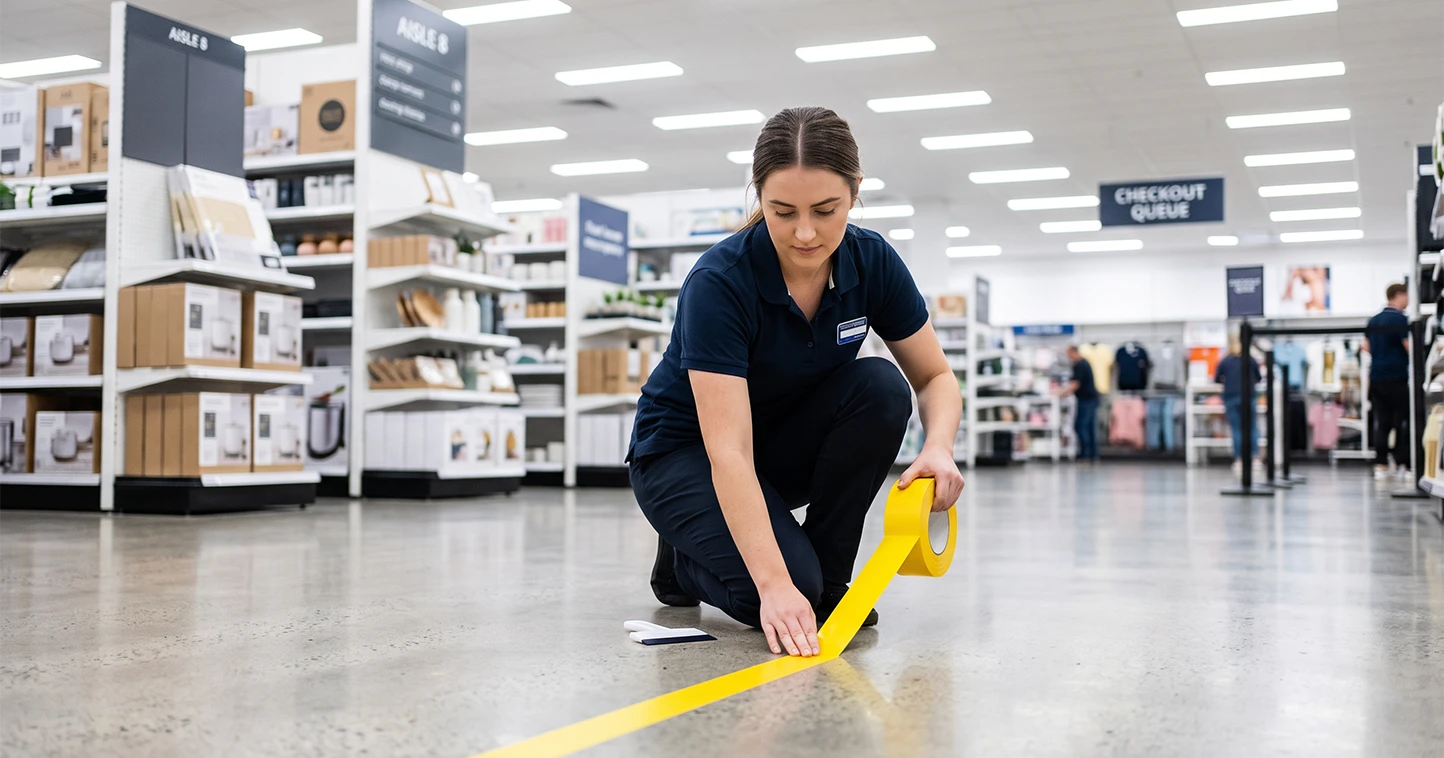
Tape serves multiple purposes in retail establishments, so operations managers and visual merchandising teams need to know which type to buy. On the floor, tape directs customers down an aisle, holds a queue in shape at the checkout, and marks the step edge.
That is where most tape buying decisions go sideways. A roll rated for a stockroom lane behaves badly on a painted endcap. A low-tack mounting tape disappears under cart traffic in a week. Floor marking tape choice is important.
Why Tape Is a Core Retail Operations Supply
Three separate line items on a store's operating budget run through the same supply closet shelf.
- Safety compliance: Step edges and ramp transitions are the items an insurance inspector photographs.
- Wayfinding: Aisle boundaries, stockroom lanes, pallet staging squares, and queue spacing at the service counter don’t need to be permanent.
- Visual merchandising: Price cards, shelf strips, sign holders, and POP displays have to attach to glass, powder-coated metal, laminate, and painted drywall.
For a broader overview of how adhesive products differ by construction and intended use, see 10 of the Most Common Types of Tape and Their Best Uses.
Floor Marking Tape for Retail Stores: Types and Applications
There are multiple applications for retail store tape:
- Plain colored vinyl for lane and boundary work
- Striped hazard tape
- Grit-surfaced tape for traction
- Die-cut shapes for queue spacing
- Photoluminescent and retroreflective films
Aisle Marking Tape
Tapes for aisle boundaries and the perimeter of seasonal sections are workhorses that you have to rebuild in the same place after a reset. In the back of the house, this tape marks stockroom lanes, pallet staging squares, and keep-clear zones.
Safety and Hazard Marking Tape
Step edges and stair nosings, ramp transitions, low-clearance beams and door headers, the clearance footprint in front of electrical panels, fire extinguisher and riser locations, and routes to exits. These are the spots where someone might walk into something.
For striping conventions, grit grades, and placement, see The Complete Guide to Safety Tape.
Queue and Line Management Markers
Customers stand directly over checkout lines and order pickup lines for minutes at a time, which means they’ll notice sloppy work. Since queue layouts shift with staffing, seasonal volume, and remodels, specify an adhesive rated for clean removal from whatever flooring the checkout area has.
For spacing layouts in customer queue areas, see Safety and Social Distancing with Floor Marking Tape.
Glow-in-the-Dark and Reflective Tape
Photoluminescent tape marks egress paths, stair treads, exit door frames, and obstruction edges. Retroreflective tape bounces light back toward its source, which makes it useful on stockroom equipment, cart corrals, dock edges, and bollards.
For reflective grades and where each applies, see The Complete Guide to Reflective Tape.
What to Look for in Retail Floor Tape
Four specs actually predict whether a tape survives a selling season:
#1 Backing Material and Durability
Vinyl conforms to minor floor texture and stretches enough to lay flat around a gentle curve. Polyester is thinner and harder, with better scuff and chemical resistance. Polyethylene is an impact-resistant option. It is also the heaviest and reads industrial rather than retail.
#2 Adhesive Strength and Removability
Rubber-based adhesives grab fast and build high initial tack, but they are less stable over time.
Acrylic adhesives start slowly, building strength as they wet out against the surface. They hold up better to temperature swings, cleaning chemicals, and long dwell.
#3 Visibility and Color Coding
Finish affects readability more than buyers expect. Gloss vinyl looks brighter and more saturated on the roll, but under high-output LED and track lighting it throws glare and can wash out at shallow viewing angles.
#4 Surface Prep and Installation Basics
Most floor tape failures are installation failures, and the shortcuts repeat. Clean properly. Sweep or vacuum, then wipe with isopropyl alcohol to pull floor finish residue, wax, and cleaner film.

Double Sided Tape for Retail Displays and Store Fixtures
The double-sided tape category includes applications such as floor lines and sign holders on glass doors.
Common Display Mounting Applications
Common display mounting applications include price cards and shelf talkers on shelf edges and rails, shelf strips and channels on gondola fronts, and header cards on POP displays.
Choosing the Right Double-Sided Tape
Foam tapes add thickness and compressibility for nonflat surfaces. On textured powder coat, slightly bowed acrylic, wood grain, or a mirror back with a gentle warp, the foam core fills the gap and keeps contact across the whole footprint instead of bridging the high spots.
For construction-by-construction bond strength comparisons, see Choosing the Right Double-Sided Tape for Your Application.
Removability on Painted Walls and Tape for Store Fixtures
Will it take the paint off? It can. Latex over drywall is the weak link in the stack. The adhesive can outmuscle the bond between paint and substrate, and a high-tack tape pulled at the wrong angle lifts paint, paper facing, or both.
Retail Visual Merchandising Tape: Additional Products Worth Stocking
A few more products handle the jobs that come up weekly and have no workable substitute when the supply closet runs dry.
Gaffer and Cloth Tape
Gaffer tape handles sampling tables and seasonal pop-ups better than anything else: the cloth backing tears clean by hand, conforms around the cable, and lies flat enough that it doesn't become its own trip point.
Clear Double-Sided Tape
Window graphics, acrylic sign faces, and glass door decals share a problem: anything mounted behind translucent material shows the adhesive. A clear polyester carrier solves it, since the bond line reads as nothing instead of a gray bar through the substrate.
Branded and Custom Printed Tape
Stores that ship, and stores that fulfill online orders from the sales floor, go through carton sealing tape quickly. Custom printed tape carries the logo, but its real value is routing information you can read without turning the carton over.
Building a Tape Program for Multi-Store Operations
A dozen stores ordering independently will end up with several shades of yellow and a mix of adhesives that behave differently on identical flooring. Standardizing SKUs handles most of that. Five or six approved items cover the overwhelming majority of what stores actually do, and consolidating onto them puts volume behind fewer line items, where pricing improves.
Getting the Best Tape for Your Specific Retail Needs
Matching specification to application is what keeps the work from coming back. The wrong adhesive on a finished floor costs solvent and scrub hours. The wrong tack on painted drywall costs a patch and touch-up. Retail operations and visual merchandising teams working through floor plans, reset schedules, or a chainwide SKU consolidation can request product recommendations, samples to test against actual store flooring and fixtures, and bulk pricing on our website. Specifying well starts with the substrate, the traffic level, and the timeline.