
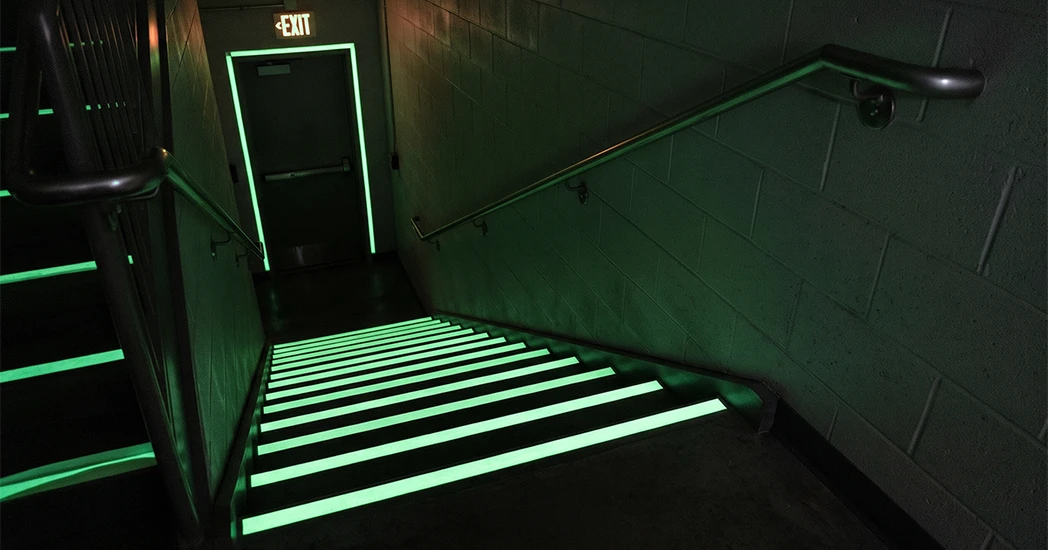
Interior stairwells and windowless corridors have no daylight to fall back on. When winter storm season knocks out power, those spaces go black, and occupants still have to find the stairs, reach an exit, and put their hands on equipment controls. Glow-in-the-dark tape gives them something to follow. It needs no wiring, no batteries, and no backup circuit, and it charges off the overhead lights already running during the workday.
That puts it in a different category from the glow tape sold for crafts and Halloween. Marking a building means stairways and handrails, escape routes, door frames, hazards, and critical controls. Tape Jungle's Premium Glow in the Dark Tape comes in 6-, 10-, and 24-hour glow durations, making safety precautions last long enough for the lights to turn back on.
How Photoluminescent Tape Works When the Power Goes Out
Photoluminescent tape stores light. The pigment in the film absorbs energy from overhead fixtures while the building has power, and releases this energy as a visible glow once the space goes dark. You don’t have to switch anything on, and no chemical reaction occurs.
That answers the first question most facilities managers ask, which is whether glow tape needs power and how long it takes to charge. It needs no wiring or electrical connection. Tape Jungle's product page lists the Premium Glow-in-the-Dark Tape as fully charged within 30 minutes of light exposure, so a stairwell in normal lighting during a shift is ready well before an outage. The film is a safety-grade, flexible, non-toxic, and non-radioactive photoluminescent polyester with a permanent acrylic adhesive, so it holds on painted steel, concrete, door frames, and handrails.
Reflective tape works the other way around. It has no light of its own and only shows up when a flashlight or headlight hits it directly, which suits vehicles and high-visibility gear but does nothing in a corridor where no one has a light. Glow tape emits.
Glow-in-the-dark tape from Tape Jungle meets or exceeds requirements for emergency egress and other safety standards. Treat it as an added marking layer behind your emergency lighting and exit signage, not a replacement for either.
Where to Apply Glow-in-the-Dark Tape in Your Building
Marking one stairwell helps the people already in it. A building-wide plan does more. Someone standing in a dark corridor should be able to see the next marking from where they stand, follow it to the stairwell, and follow the stairwell down to an exit. Gaps in that chain are where people stop and wait.
Most facilities start with stairs. Glow-in-the-dark tape for stairs usually runs along the leading edge of each tread and along handrails, so the path reads as a continuous line rather than scattered marks. Landings, turns, and the top and bottom of each flight deserve attention, since those are the spots where people hesitate. One caution: glow tape marks an edge; it does not add grip. Where traction on the treads is also a concern, pair it with a non-skid product.
From there, work outward to escape routes and exits. Along with exit and directional markings, the Glow Tape category lists door frames and columns. Outlining a frame or wrapping a column at eye level gives occupants something to aim for in open floor plans and long corridors, where floor-level markings disappear behind furniture and foot traffic.
Hazards are the next layer: a step down, a low beam, a dock edge, equipment that juts into a walkway. Anything that reads as an obstacle in daylight becomes a trip hazard without it.
Many people overlook controls. Marking light switch covers and critical equipment controls means maintenance staff and responders can reach a switch, panel, or shutoff without sweeping a flashlight across the wall to find it.
Choosing Glow Tape: Glow Duration, Width, and Roll Size
Ordering comes down to three specs: glow duration, width, and roll length.
How Long Does Glow Tape Glow?
Tape Jungle's Premium Glow in the Dark Safety Tape comes in 6-hour (76019), 10-hour (76030), and 24-hour (76050). Those numbers are approximate, measured in a completely dark room, for the night-adapted eye, so how much light the tape soaked up beforehand and how much ambient light remains in the space both shift what people actually see.
Match the duration to your outage plan rather than to the room. A space that empties in ten minutes and a space maintenance has to re-enter at hour six are different problems, and your evacuation and response timelines are what should settle it.
How Wide Is Photoluminescent Tape?
Widths are 1/2", 3/4", 1", 1.5", 2", 3", and 4". The narrow sizes go where the marking has to fit something small: a switch cover, a handrail, a control panel edge. Wider stock holds its line down a corridor and reads as one continuous path across stair treads and escape routes instead of a row of dashes.
What Are the Available Tape Lengths?
Rolls come in 10 yards or 50 yards. Ten yards suits spot marking and trial placement before a full order goes in. Fifty yards covers stairwells, corridors, and multi-floor runs with fewer splices in the line, which matters when the whole point is an unbroken path.
For hazards that also need to be visible with the lights on, the full Safety Tape range covers daytime marking.
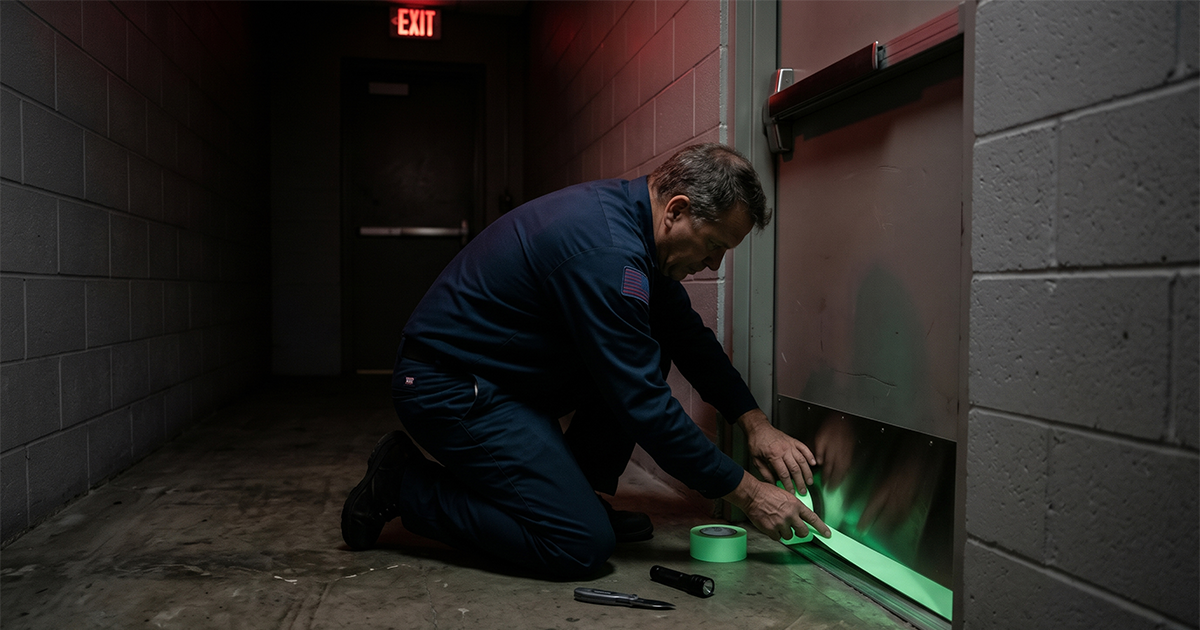
Installing Glow-in-the-Dark Safety Tape Before Winter Storms
Cold is the one thing that complicates installation. The tape handles a temperature range of -20°F to 125°F once it is down, but it needs at least 50°F and a clean, dry surface to go on in the first place. Unheated stairwells, loading docks, and exterior landings drop below that in most climates by December, which is why this work belongs on the fall schedule. Where the season has already turned, warm the space and the surface first, then apply.
Cold weather is half of the question buyers tend to ask here. The other half is whether the glow-in-the-dark tape for stairs can go outdoors at all. It has excellent resistance to UV light and does not show significant degradation when used outdoors.
Checking Your Tape Installation
Installation is only the start. Walk the building with the lights off before marking and again afterward, since dark zones are rarely where people assume they are, and the gaps in a path of travel only show up when the lights are actually off. Check that marked surfaces still see normal lighting. Tape behind a stack of pallets or tucked under a shelf never charges.
Add the markings to the regular maintenance round. Dirt, scuffing, and lifted edges all cut into what occupants can see, and those sections need cleaning or replacement before anyone notices them during an outage.
Then write the marked areas into the emergency preparedness plan and brief staff on what they mean. A glowing line along a handrail works better when people already know it is there.
How Visibility Impacts Work Safety
Visibility is the common thread through every one of these decisions. People move confidently when they can see where the floor ends, where the door is, and where the panel sits on the wall. Take that away and movement slows, hands go out for walls, and a routine trip down two flights turns into something people do carefully and slowly.
That matters beyond evacuations. Maintenance crews re-enter dark buildings to reset equipment. Security staff walk floors during an outage. Housekeeping, night shifts, and contractors all work in spaces where lighting is not steady. Marked edges, marked routes, and marked controls shorten the time it takes any of them to orient and move.
None of this replaces emergency lighting or exit signage. It sits underneath both, holding the route together in the seconds before backup systems come up and in the corners those systems do not reach.
Tape Jungle Helps You Manage Safety
Tape Jungle has the tape options you need to mitigate safety hazards. Glow-in-the-dark safety tape keeps stairs, exits, hazards, and controls visible when the power fails, and the work goes in before the winter storm peak, not during it. Compare glow durations, widths, and roll sizes on the Premium Glow in the Dark Tape product page, or browse the full Glow Tape category to plan a building-wide marking program.


